
SUMMARY
NatWest Group is the biggest supporter of the business sector — banking around 1 in 4 businesses across the UK and Ireland, from start-ups to multi nationals. NatWest Group is the biggest supporter of the business sector — banking
With Bankline you can view all your accounts on one profile, create multiple users with customised roles and make payments of all sizes securely. It's a digital platform designed to put you in control of your business finances.

Project kickoff
We began the project by meticulously planning our approach, which included defining clear objectives, conducting thorough user research, and crafting detailed personas and journey maps. We then iteratively developed wireframes and prototypes, testing and refining them based on user feedback. This methodical process ensured the creation of a final product that not only met but exceeded user expectations for a seamless and intuitive experience.
Stakeholder mapping

Created stakeholder maps to identify and prioritize key individuals or groups involved in or affected by the project. This helped us understand their interests, influence, and level of involvement, facilitating effective communication and stakeholder management throughout the project lifecycle.
Focus group discussions
We organized 2 focus group discussions to gather qualitative insights from representative users or stakeholders. These sessions provided valuable feedback and perspectives, helping us refine our understanding of user needs and preferences, and informing decision-making throughout the project.
Customer interviews
We conducted a total of 21 interviews with customers representing diverse segments including large corporates, small corporates, mid-sized corporates, government entities, schools, and councils. These interviews allowed us to gather insights tailored to each segment's unique needs and preferences, providing a comprehensive understanding of our customer base.
Feature listing
Created a comprehensive feature list based on the insights gathered from the interviews with customers across various segments. Utilizing this list, we prioritized features and established a JIRA backlog. This organized backlog served as a roadmap for development, ensuring that the most critical features were addressed first while maintaining flexibility for adjustments based on ongoing feedback and iterations.

What is Bankline
Bankline gives you the flexibility to view all your business accounts on one profile, make payments securely, and create multiple users with different access levels.Bankline is suited to businesses that need a customisable digital banking service with a range of user management options

Bankline User level access control
Identifying that 22% of the pain points lie within the admin journey of Bankline users offers a crucial insight into the specific areas where users encounter challenges or inefficiencies. The admin journey typically encompasses tasks related to account management, user permissions, security settings, and other administrative functions crucial for managing accounts and overseeing operations within Bankline.
Within this context, uncovering a significant portion of pain points suggests that users encounter notable difficulties or frustrations while navigating through these administrative tasks. These pain points could range from complex user interfaces, confusing workflows, time-consuming processes, to security concerns or errors in executing administrative actions.
To address these pain points effectively, it's imperative to delve deeper into understanding the specific issues users encounter within the admin journey. This could involve conducting targeted user research, such as usability testing, interviews, or surveys, to gain insights into users' experiences, challenges, and expectations. By identifying and analyzing user feedback and behaviors within the admin journey, teams can pinpoint the root causes of the pain points and devise targeted solutions to address them.
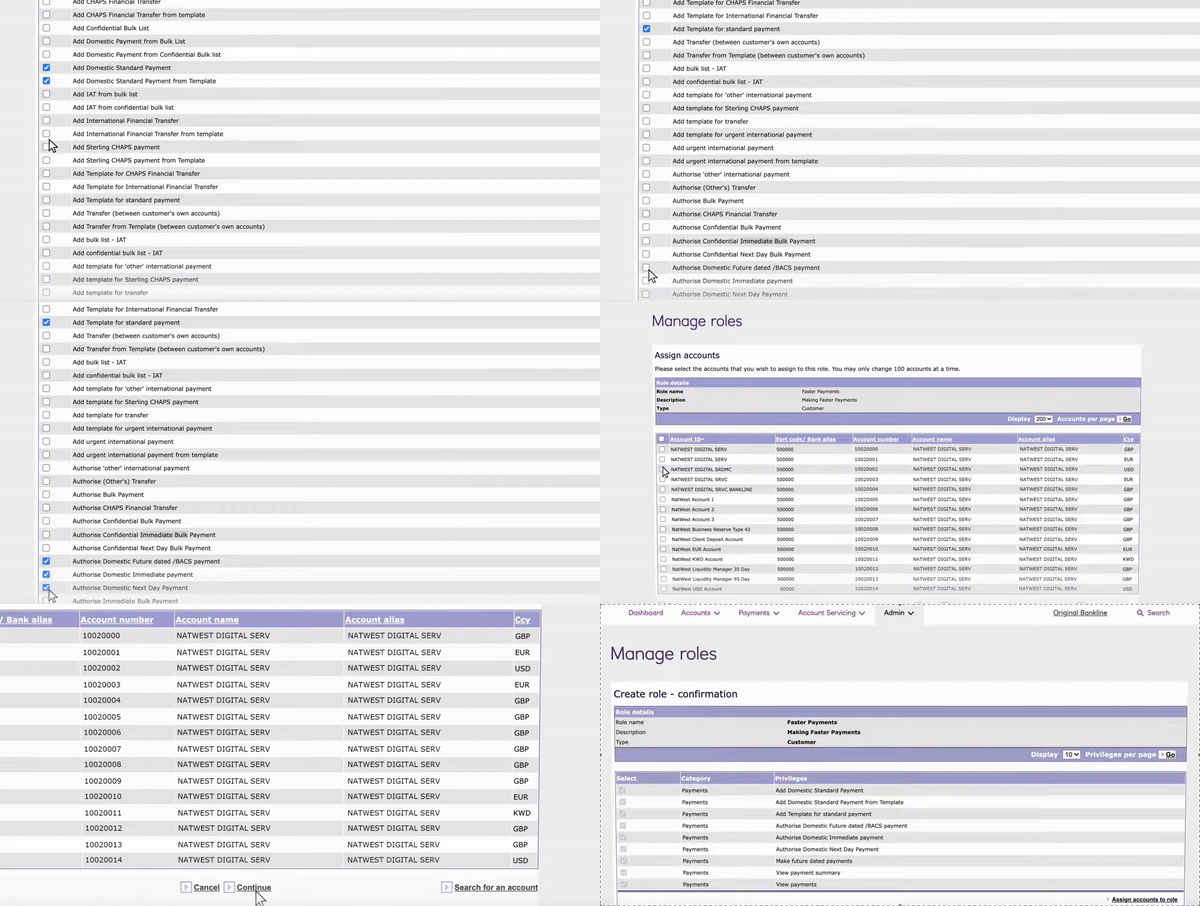
Complex dashboards and user stories
The complexity of the current user journey stems from the absence of dynamic dashboards and comprehensive user guides within the Bankline platform. Dynamic dashboards provide users with real-time insights and personalized data visualization, allowing them to monitor key metrics, track performance, and make informed decisions efficiently. Without such dashboards, users may struggle to access relevant information quickly, leading to delays, inefficiencies, and frustration in navigating through the platform.
Additionally, the lack of comprehensive user guides exacerbates the complexity of the user journey by depriving users of essential guidance and support in using Bankline effectively.

Deciphering the Five W's: An Investigation into Bankline User Profiles and Activities
What?
The topic or subject matter being investigated.
Who?
The participants or subjects involved in the study.
When?
The instances when a particular issue occurred
Where?
The touchpoint or context in which the research takes place.
Why?
The purpose or rationale behind the pain points.
Focus Group Discussions
As a generative research method, Focus groups were conducted where some experienced individuals were invited together in the same room to discuss about Bankline and the customers.We hoped to stimulate discussionsa bout user journeys which might have been missed before. 2 Focus groups were conducted with subject matter experts from the product and proposition perspective and other one from the customer service perspective of Bankline

Mapping the as-is customer journey
After conducting Focus Groups, an End-to-End Customer Journey Map was crafted, reflecting the current user experience. Utilizing artefacts collected during the focus groups, such as Onboarding documents, Digital cards, Offline touchpoints, and identified gaps, the journey was meticulously mapped on Figma. This dynamic map evolved continuously as more insights were gathered from customers and stakeholders throughout the research process.

What users had to say
A detailed research was conducted with the different personas identified. The interview conducted identified the pain points, experiences and opportunity areas for the user.
Lack of user guidance
Customers logging in expressed confusion: 'What can I do? I can't see anything!'"
Discontinuous process for
setting up roles
"Create new user & Manage roles is confusing. No way to save information"
No way to search data
"Large business have complex datasets. No way to search it on Bankline"
Complex role creation
"Things are not covered in the master roles, hence new custom roles are created every time"
Linking user roles & accounts
"Not possbile to duplicate roles and link it to a different acccount"
Dual admin issues
"Not possbile to duplicate roles and link it to a different acccount"
Sensitive data exposed
"Users are nervous while adding new users as they dont want all accounts to be seen "
Self service issues
"No way to self service. Agents cannot take decision on behalf of customers when required"
Confusing master roles
Current master roles overlap each other and include duplicate privileges"
Motivations for using Bankline
Different customers use Bankline for different reasons. We asked participants to identify some of the reasons customers chose Bankline.
"To have financial literacy (smaller businesses)"
"To manage more accounts seamlessly"
"To have certain level of access control on accounts and users "
"To have currency accounts"
"To make international payments"
" To cater to needs of the growing organisation "
What we understood
We learnt Bankline is a relatively complex product due to the diverse needs of the customers from varied customer segments


Ideation workshops
During this session we collaboratively explored concepts and ideas to reimagine the experience of a specific project area. We created a Figma board which had specific artefactssuch as user type, jobs to be done, the user journey, voting board and space for quick wireframing.
Introduction and Ice breaker (10 mins)
Kick off the session with introduction of the participants. Then introduce the topic and area and focus of the workshop. Have some ince breakers for introductions
Review focus area and JTBD (20 mins)
Review the area of focus - the customer journey, screenshots, user paint points, opportunity areas, JTBD and Personas to understand the in-depth journey
Agree on goal and outcomes ( 10 mins)
Collaboratively agree the goal of the workshop so everyone is working towards same outcomes and clear with the session progressing forward
Ideation session (20 mins)
Begin the ideation session with the timer for 20 mins where everyone can quickly sketch out their ideas on paper
Present back ideas (5 mins)
Everyone gets 5 mins to present back their ideas to the team
Vote (5mins)
Everyone votes for the ideas. One can vote for their own idea or someone else's. A decision maker has additional votes
Impact effort matrix (20mins)
Each journey had an impact matrix where are participants can map an idea on the basis of High impact, Low Impact, High effort, Low effort
Ideation workshops
During this session we collaboratively explored concepts and ideas to reimagine the experience of a specific project area. We created a Figma board which had specific artefactssuch as user type, jobs to be done, the user journey, voting board and space for quick wireframing.

Visual explorations


